
12.28.2013

12.12.2013
Cold Storage

It was my second year at BYU. I was immersed in a culture of not just Mormons, but Mormons on a mission to get married. Dating was the topic of the month, and the month after that, and the one after that as well. A hefty handful of girls from the floor of my freshman hall had already gotten married at the ripe old ages of 18, 19, and 20. I was flabbergasted. I didn't understand how any of the so-called students at my university were concentrating on anything remotely academic. The dating culture seeped in the widows, it permeated walls and carpets. Everything we touched and breathed was infused with this powerful force. Sometimes it was suffocating. Sometimes I longed for my home in the east.
By this point in my sophomore year, I had reluctantly agreed to a stream of date invitations. I always appreciated the free meal and the kindness offered me by the unsuspecting suitors, but I would have preferred to eat cold beans and rice by myself. Typically, there were no repeat invitations. I was shy and cold as my coveted beans, a true turnoff. Finally, one young man from choir apparently couldn't read my body language. After two consecutive dates, he suggested a third and I flatly refused.
"You're a nice guy, but I can't drag you on. It's not going to go anywhere with me."
Having done the right thing, I hung up the receiver feeling gut-wrenching horrible. I went to moan about it to one of my roommates. She offered me her shoulder and then she offered a solution. She had come back from her recent trip to China with bargained goods. Music, movies, clothing, and jewelry, all for the price of dirt cheap. The ring was hers and so was the idea. "Wear this on the finger that matters," she said, eyes twinkling, " and you'll never be asked on another date!" I slipped it on and pranced around the room flouncing my hand like a preteen with her first manicure.
12.03.2013
This Place I Love
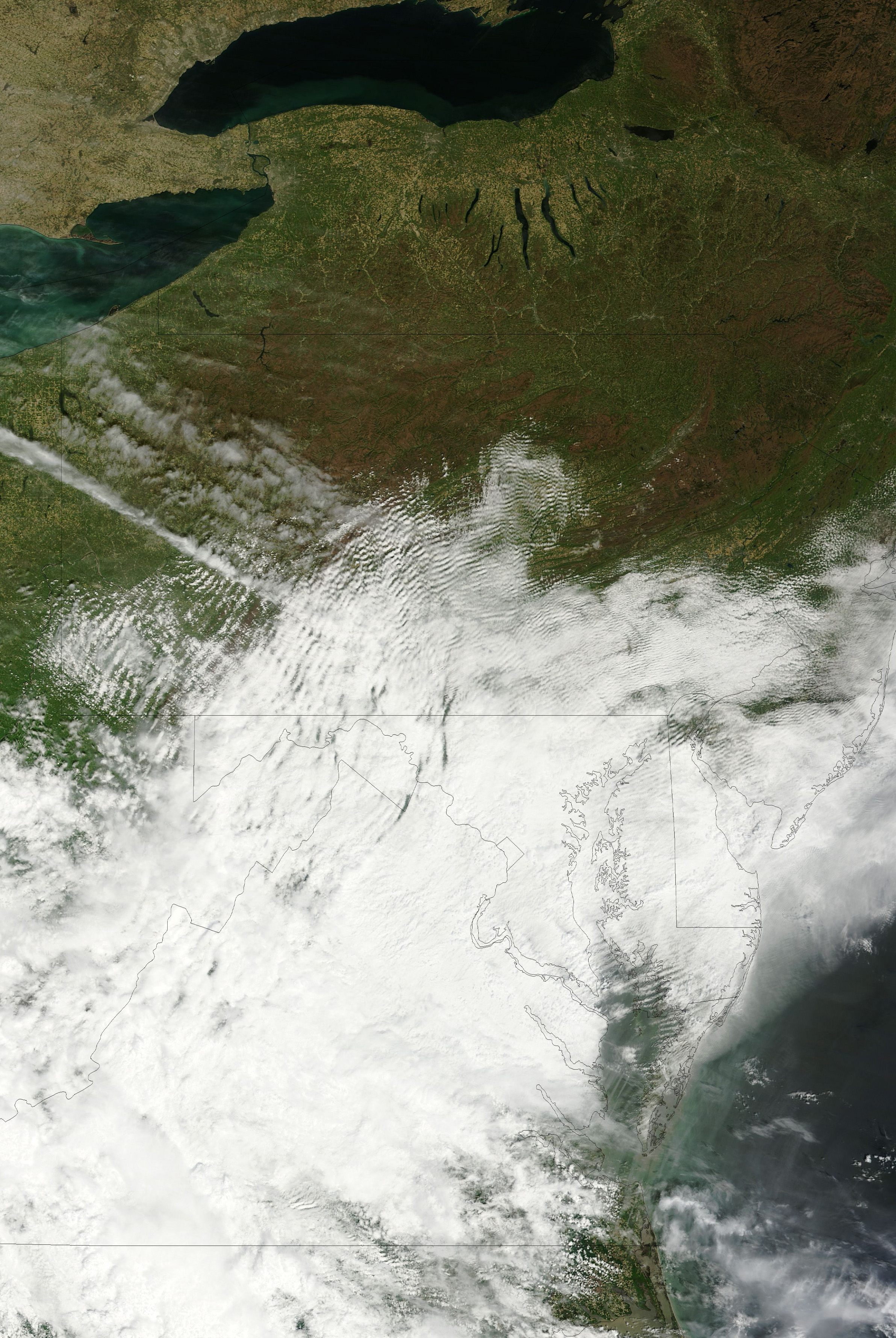
acquired May 6, 2013download large image (2 MB, JPEG, 2384x3560)
The Finger Lakes—a group of long, roughly parallel lakes in upstate New York—got their name for obvious reasons. On a map, the narrow lakes look similar to outstretched digits. Seneca and Cayuga—the two largest Finger Lakes—are among the deepest lakes in North America. Lake Cayuga descends about 435 feet (133 meters) at its deepest point—putting it about 53 feet (16 meters) below sea level.
On May 6, 2013, the Moderate-resolution Imaging Spectroradiometer(MODIS) on NASA’s Terra satellite acquired this true-color image of the Finger Lakes. Lake water appears dark blue. Farms and orchards, mainly around the northern part of the lakes, are beige. Forested areas south of the lake are brown because leaves had not fully emerged in early May. However, grass and other low-lying vegetation in meadows had turned some parts of the landscape green.
Millions of years ago, the lakes were northward-flowing streams that ran through a series of narrow valleys shaped like a V. Beginning about two million years ago, during a period known as the Pleistocene glaciation,sheets of ice from the Hudson Valley crept south and buried those streams under ice.
As the glaciers pushed south, they gouged the bottom and sides of the narrow valleys, deepening and widening them into vertical U shapes. This process, known as glacial scouring, likely happened multiple times as orbital variations in global climate—called Milankovitch cycles—produced cycles of advancing and retreating ice.
The most recent glacial advance occurred about 21,000 years ago, when a layer of ice about two miles (three kilometers) thick covered all of New York State and much of New England. The glaciers advanced and retreated, sliding back for the last time about 10,000 years ago. In the process, they left debris piles called recessional moraines in the valleys. In many cases, these moraines functioned like dams, blocking streams and causing the valleys to fill with water and become lakes.
References
- Cornell University Finger Lakes: Graphics. Accessed October 8, 2013.
- Paleontological Research Institution Finger Lakes Geology. Accessed October 8, 2013.
NASA image courtesy of the LANCE/EOSDIS MODIS Rapid Response Team at NASA GSFC. Caption by Adam Voiland.
- Instrument:
- Terra - MODIS
12.02.2013
November Tradition
During the month of November, we fill a decorated mason jar up with scraps of paper on which we write something we are grateful for. The family night before Thanksgiving we dump out the contents and read every scrap of thankfulness. Some make us laugh. Some make us think. Some make us feel gratitude all over again. Some are not for public consumption. All are sincere. Here is our (public) list for this year...
Someone in our family is thankful for:
Music and dancing
Dada
All of the art projects that Nolan and Gerret make for me
Grandpa's cookies
Auburn's kind looks
My mom and dad and my brother and my sister and cats and dog
Family (x2)
"Doc-Doc"
The Book of Mormon (x2)
living in the beautiful, calm, quiet country --with Amish people
orange sweaters that look good on my wife
going on runs around my backyard
God
my "manket" (blanket)
pumpkins
the world
IBuprofen
having friends
Cinder
sinks that drain
Snoogy-woogy Wips
Someone in our family is thankful for:
Music and dancing
Dada
All of the art projects that Nolan and Gerret make for me
Grandpa's cookies
Auburn's kind looks
My mom and dad and my brother and my sister and cats and dog
Family (x2)
"Doc-Doc"
The Book of Mormon (x2)
living in the beautiful, calm, quiet country --with Amish people
orange sweaters that look good on my wife
going on runs around my backyard
God
my "manket" (blanket)
pumpkins
the world
IBuprofen
having friends
Cinder
sinks that drain
Snoogy-woogy Wips
Subscribe to:
Posts (Atom)